-
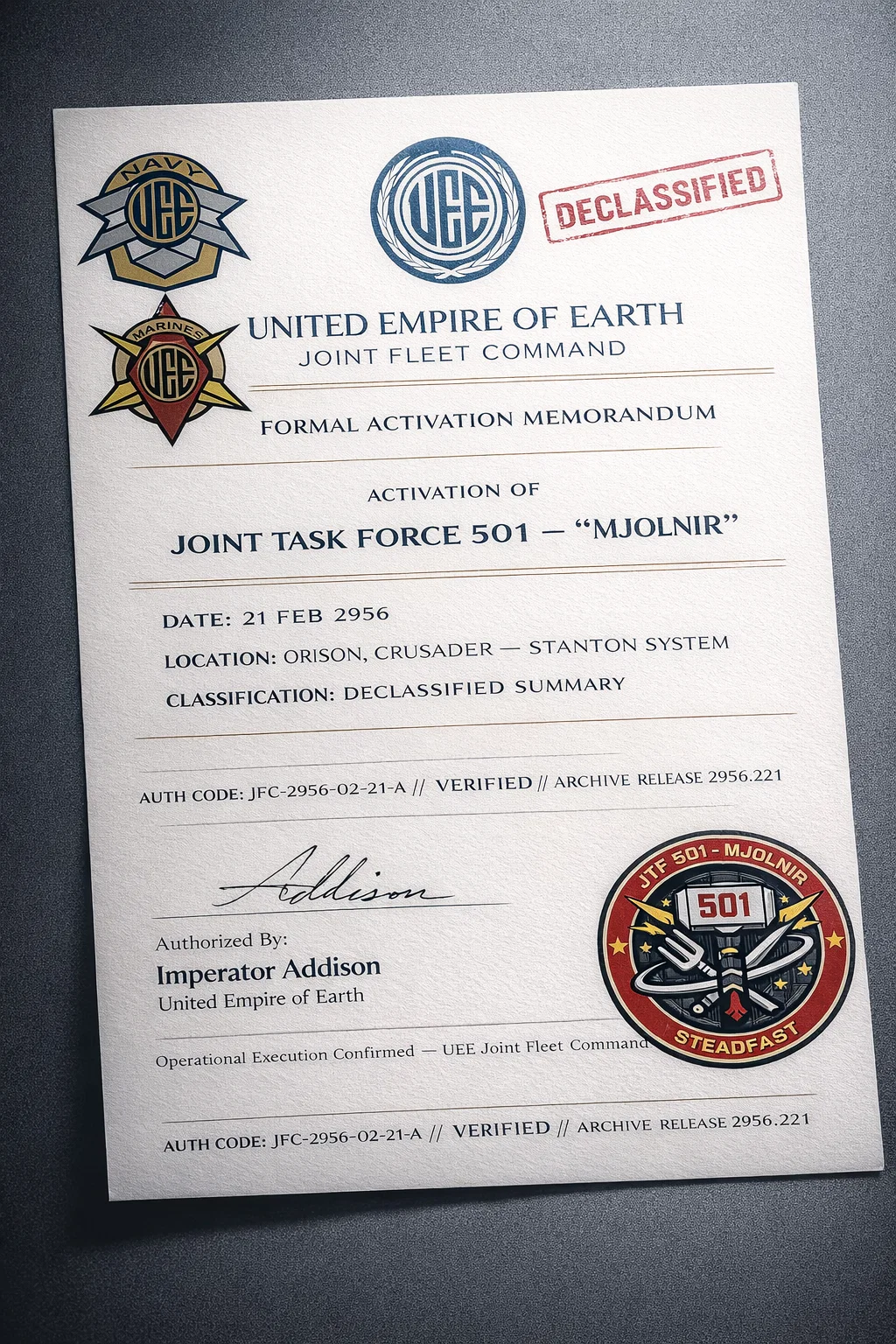
UNITED EMPIRE OF EARTH NAVY JOINT FLEET COMMAND FORMAL ACTIVATION MEMORANDUM
DATE: 21 FEB 2956 LOCATION: Orison, Crusader — Stanton System CLASSIFICATION: DECLASSIFIED SUMMARY
SUBJECT: ACTIVATION OF JOINT TASK FORCE 501 – “MJOLNIR”
By authority of Joint Fleet Command, under mandate of the Office of the Imperator, Joint Task Force 501 (JTF-501) is hereby activated as a UEE-affiliated joint operational formation.
Headquartered at Orison, Crusader, JTF-501 will operate throughout the Stanton, Nyx, and Pyro systems.
STRATEGIC CONTEXT
In response to destabilization within Pyro, Frontier-aligned insurgent activity, renewed Vanduul probing actions, and evolving conditions in Nyx, Joint Fleet Command authorizes a scalable joint element capable of stabilizing frontier space without full battlegroup deployment.
JTF-501 is tasked to deter incursion, augment civilian defense, preserve lawful transit, and conduct expeditionary stabilization operations.
FLAGSHIP The UEES Sleipnir is hereby designated flagship of Joint Task Force 501.
ASSIGNED COMPONENTS
UEE Navy
• 7th Expeditionary Battle Group
• 724th Astral Strike & Interdiction Wing
• 75th Naval Security Battalion
• 1st Strategic Sensor Activity
• 21st Operational Support Group
UEE Marines
• 15th Marine Expeditionary Rapid Response Group
• 160th Strategic Orbital Aerospace Regiment
• 22nd Orbital Shock Regiment
• 5th Pathfinder Reconnaissance Squadron
• 6th Forward Operations Support Group
DESIGNATION NOTE
“501” reflects historic registry lineage and Terran martial tradition symbolizing cohesion, elite forward posture, and disciplined shock response. Archival references remain restricted.
MOTTO
STEADFAST
Response: “REMAIN STEADFAST.”
Authorized By: Imperator Addison United Empire of Earth
Operational Execution Confirmed — UEE Joint Fleet Command
-
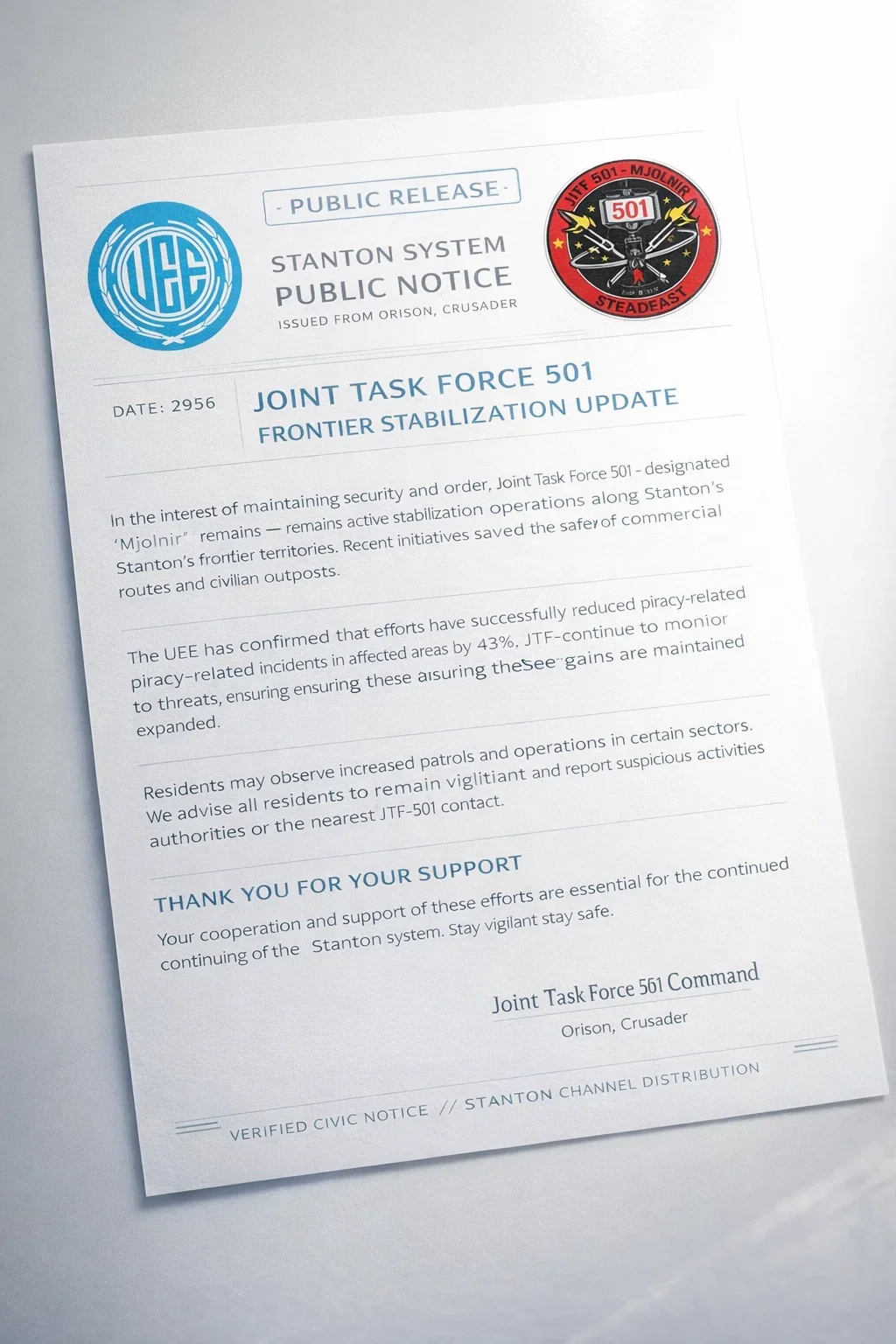
Public Notice — Stanton System
Joint Task Force 501 Frontier Stabilization Update
Issued from Orison, Crusader — 2956
Residents, contractors, and commercial operators of the Stanton System,
Joint Task Force 501 – MJOLNIR remains actively deployed in support of frontier stability operations throughout Stanton and adjacent transit corridors.
Our current fleet posture is centered on expeditionary-ready Polaris-class corvettes, optimized for rapid response and corridor security. While effective for immediate deterrence, long-term stabilization requires expanded capital capability.
To that end, JTF-501 has initiated cooperative engagement efforts with:
• Local defense organizations
• Industrial partners
• Independent contractors
• Civilian commerce networks
• Banu trade intermediaries operating within Stanton
Through voluntary exchange and structured trade agreements, rare materials and high-value commodities are being consolidated to support the negotiated acquisition of an additional capital-class platform to enhance regional security posture.
This initiative is:
• Voluntary
• Cooperative
• Community-supported
• Focused on increasing Stanton’s resilience
No requisitions.
No levies.
No compulsory contributions.
Our objective is simple:
Strengthen the system from within.
Stanton thrives because its citizens do not wait for rescue — they build stability together.
Joint Task Force 501 remains committed to safeguarding lawful transit, protecting civilian commerce, and deterring hostile incursion.
STEADFAST.
REMAIN STEADFAST.
— Joint Task Force 501 Command
Orison, Crusader
-
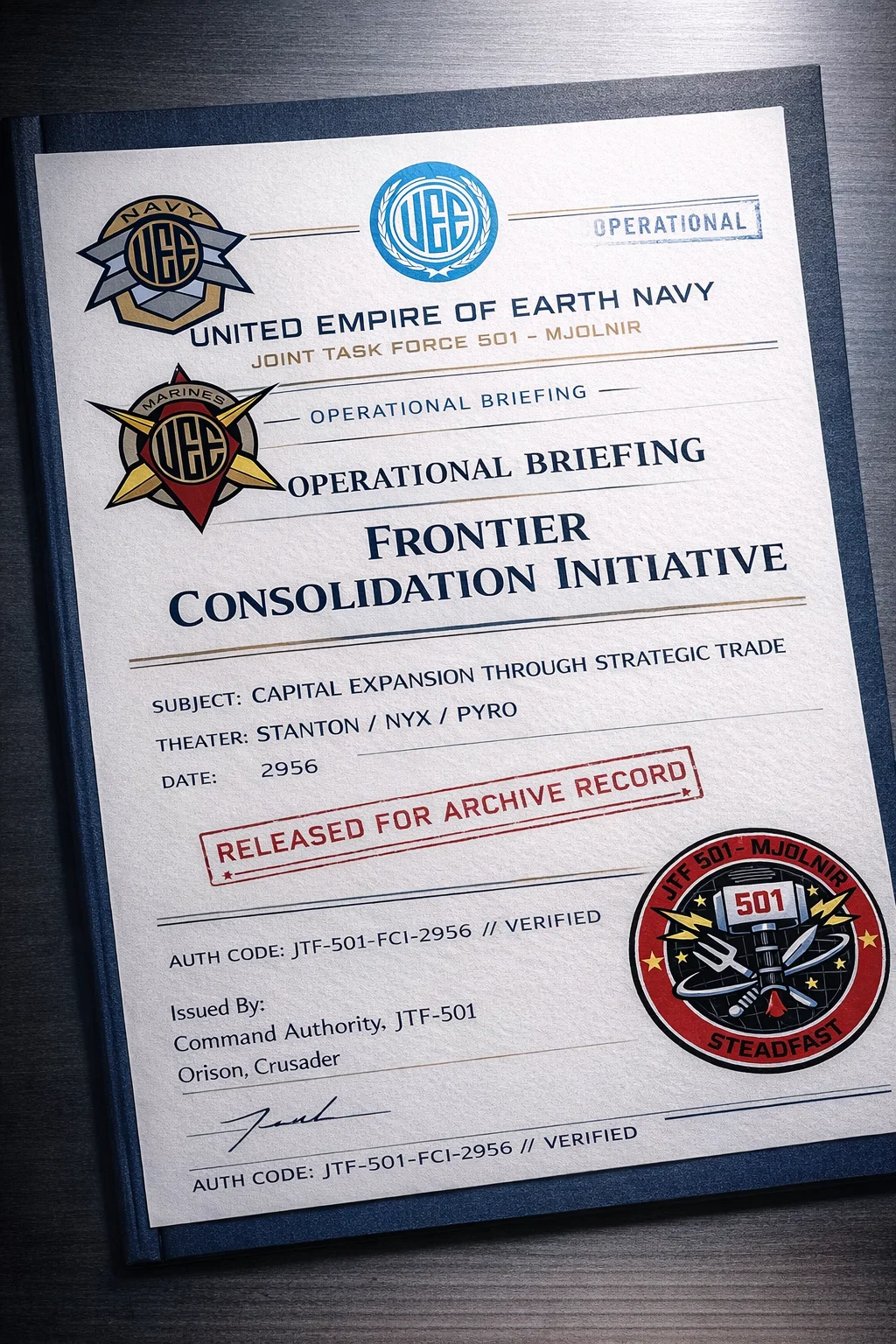
Frontier Consolidation Initiative — Stanton
The Idris Objective
03 March, 2956 — Orison, Crusader
Joint Task Force 501 deployed to Stanton under accelerated orders. Larger fleet assets were unavailable — committed to Vanduul-border rotations, refits, or Senate-prioritized deployments. Heavy hull inventory across the UEE remains strained.
JTF-501 arrived with Polaris-class corvettes as primary anchors — fast, lethal, expeditionary platforms capable of rapid projection without full battlegroup mass.
It established presence.
It did not establish dominance.
Operational Reality
Stanton’s civilian defense forces remain capable but lack sustained capital deterrence. Pyro instability continues to spill across transit corridors, and Nyx remains strategically sensitive.
Petitioning for destroyer-level reinforcement would require long-cycle authorization.
JTF-501 chose another path.
Commerce as Force Multiplier
Rather than await reassignment of fleet-grade hulls, the Task Force began structured engagement with:
• Local defense partners
• Industrial stakeholders
• Civilian commerce networks
• Banu trade intermediaries
Among these is a Banu merchant operating within Stanton’s exchange circuits — Wikelo — known for unconventional barter negotiations involving rare and strategic assets.
Banu trade does not respond to rank.
It responds to value.
The Idris Initiative
The Idris-class frigate represents a scalable expansion of JTF-501’s operational reach — independently deployable, symbolically powerful, and capable of sustained deterrence.
Through cooperative acquisition efforts, rare materials and high-value trade commodities are being secured in partnership with Stanton’s populace.
Not requisition.
Not taxation.
Voluntary exchange.
A Task Force strengthening itself through the system it protects.
Polaris hulls remain the anchor.
An Idris would signal permanence.
Negotiations continue.
-
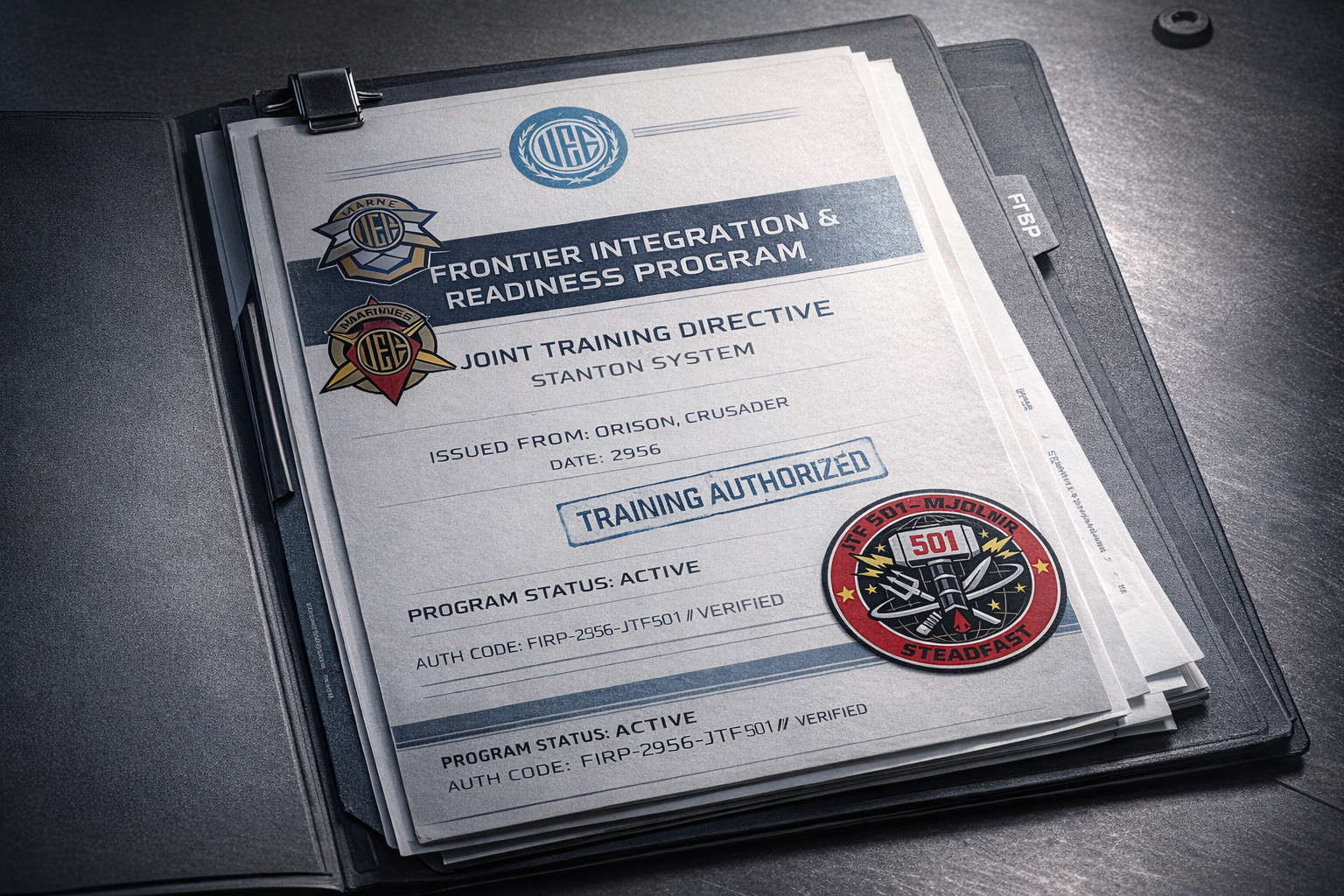
Frontier Integration & Readiness Program (FIRP)
Joint Training — Stanton System
2956 — Orison, Crusader
Following deployment to Stanton, Joint Task Force 501 identified a key reality:
The system was not undefended.
It was uncoordinated.
Civilian security, contractors, and corporate defense forces operate with capability—but without unified doctrine or integration with UEE forces.
JTF-501 was deployed to integrate, not replace.
Program Overview
In coordination with local authorities, JTF-501 established the:
Frontier Integration & Readiness Program (FIRP)
Designed to improve:
• UEE–civilian interoperability
• Crisis response coordination
• Small-unit tactics and communication
• Survival and recovery capabilities
• Lawful engagement procedures
All training is sanctioned, controlled, and authorized.
Training Methodology
FIRP uses structured simulations across Stanton infrastructure:
• Detention facilities
• Security outposts
• Industrial zones
• Transit corridors
Participants operate within defined roles to simulate hostile actors, detainees, and response forces.
All non-UEE participants are considered designated roleplayers under training conditions.
SERE Training Evolutions
Core exercises include Survival, Evasion, Resistance, and Escape (SERE) scenarios:
• Controlled detention
• Coordinated escape and evasion
• External recovery and extraction
• Identity restoration through authorized systems
These exercises simulate real conditions using sanctioned environments and authorities.
They are not punitive.
They are instructional.
Community Integration
FIRP is voluntary.
Local participants may:
• Join training exercises
• Support scenario operations
• Enhance realism and coordination
• Build interoperability with UEE forces
The objective is not control.
It is shared capability.
Strategic Impact
FIRP strengthens:
• Mixed-force readiness
• Civilian survivability
• Trust between UEE and Stanton
• System-wide defense cohesion
Stanton is secured not by presence alone—
But by prepared people.
STEADFAST.
REMAIN STEADFAST.